
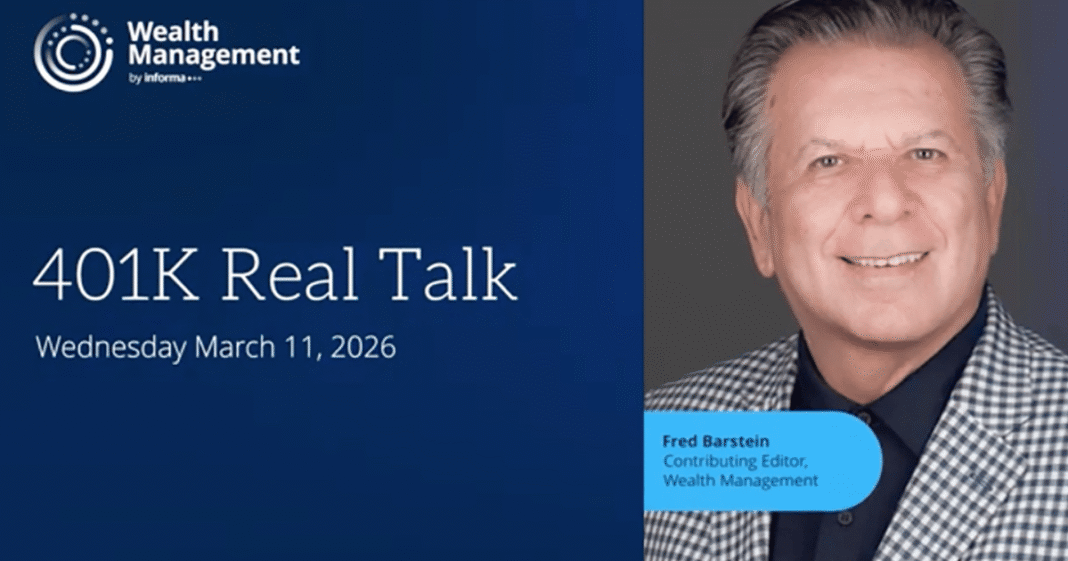
Welcome to this week’s edition of 401(k) Real Talk, where Fred Barstein, contributing editor for Wealth Management’s RPA channel, reviews all of last week’s industry news and selects the five most important/interesting stories.
Worth reading/listening/noting:
Read the full raw transcript below:
Greetings & a warm welcome to this week’s edition of 401k Real Talk. This is Fred Barstein contributing editor at WealthManagement’s RPA omnichannel and CEO at TRAU, TPSU & 401kTV – I review all of this week’s stories and select the most important and interesting ones providing open honest and candid discussion you will not get anyway else. So let’s get real!
FIRST STORY
On the heels of the Focus research which indicated that a majority of wealth advisors are converting at least 6% of DC participants into clients, and larger ones even more, Cetera’s president, Christian Mitchell, reports that the firm which has 12,000 reps is focused on the workplace to grow leveraging their retirement plan advice platform.
Not coincidentally, CEO Mike Durbin comes from Fidelity which is the leader in gathering wealth assets from DC plans.
Along with the tax channel, CPAs, and online leads, Mitchell indicated that their focus will be on retirement plans and the 700 W-2 RIAs.
Convergence of wealth and retirement is no longer a fad or pipedream as some lobbyists and industry laggards have been claiming with latecomers scrambling to catch up. Next up will be benefits.
Next story:
The father of fiduciary, Fred Reish, recently named Director of ERISA and Fiduciary Strategy for Prime Capital, succinctly outlines considerations when plan change record keepers which include:
Reish reminds plan sponsors that they are held to a very high standard as a prudent expert which means that most must rely on their advisor to help. Not mentioned is how plans are expected to conduct prudent due diligence on their advisor.
As fees decline and the cost of services increase, expect more consolidation as 2nd and 3rd tier providers struggle to keep up. And though benchmarking is helpful, it cannot nor should it replace periodic RFPs for obvious reasons.
Next story:
A leading wealth, retirement and advisory firm details what plan sponsors should be asking of their vendors which could indicate that a change is needed.
At the top of the list is how to create a competitive plan to help with recruiting and retention followed closely by whether fees are reasonable and transparent. They should also be asking if the investments are appropriate for their employees along with whether the cost of investments are reasonable and performance is competitive.
Though indirect payments to record keepers are hard to quantify for each plan, they do limit which investments are offered.
All of which will lead employersd to decide whether it is time to make a change and, if so, what are the next steps.
FINALLY
Change happens slowly in the defined contribution world, but it does happen – eventually. No dramatic changes have occurred since auto features in the 2006 Pension Protection Act – 20 years later, many plans are still slow to adopt. All of which could change as plan sponsors wake up and demand changes as well as the economic realities for providers and advisors.
Read my recent WealthManagement.com/RPA column about how more employers are incorporating phased retirement and how advisors and providers should be pivoting.
FINISH
So those were the most important stories from the past week. I listed a few others I thought were worth reading covering:
-
More private credit firms cap redemptions
-
Morningstar details TDFs rapid rise
-
AI needs ethical guardrails
-
ICI reviews 5500 trends
-
Todd Kading explains how the difference between sales and distribution
Please let me know if I missed anything or if you would like to comment. Otherwise I look forward to speaking to you next week on 401k Real Talk.