
What happened to mortgage rates this week?
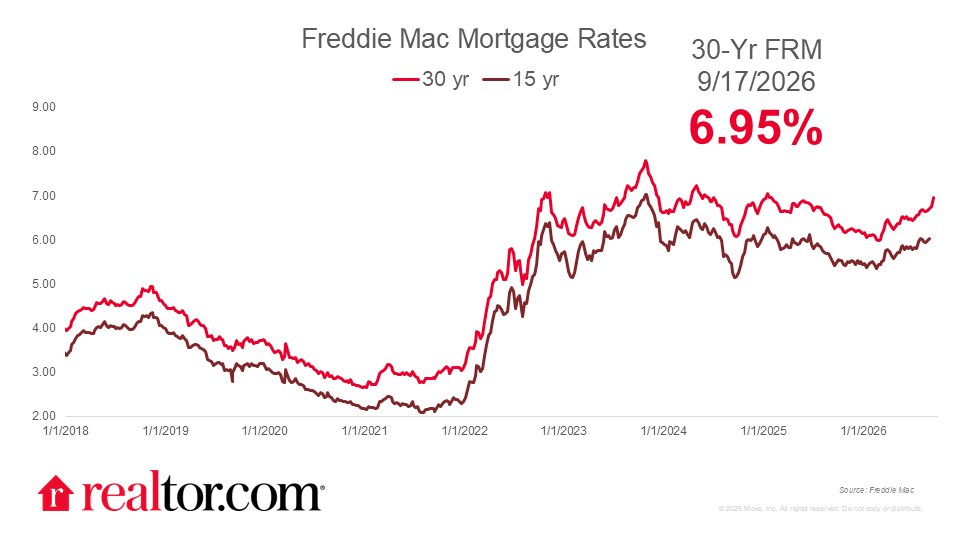
The Freddie Mac 30-year fixed mortgage rate jumped to 6.95% this week, the highest reading since January 2025. The 19 basis point surge from last week’s 6.76% is also the largest one-week increase since April 2025. Mechanically, the primary driver is rising 10-year Treasury yields, which climbed through the week and reached their highest levels since 2007 (5.04%) during intraday trading on Tuesday. Underneath the surface, though, there are many drivers, and they run well beyond yesterday’s Fed meeting. Regardless of how we got here, the cumulative move is what buyers will feel. Mortgage rates are now up 30 basis points in the past four weeks, 40 basis points over two months, and close to 100 basis points since the Iran war began in late February. Year-over-year comparisons are not pretty either: after sitting below 2025 levels through July, mortgage rates are running nearly 70 basis points above last year, a gap that has widened quickly because rates were falling last September and are climbing this one.
The FOMC raised the federal funds rate by a quarter point yesterday to a range of 3.75 to 4.00 percent, and did so unanimously. A quick caveat on timing: the Freddie Mac reading is an average of mortgage rates over the past week, so yesterday’s decision does not necessarily show up in today’s number. That said, it is not clear whether the Fed hike was already baked into the 10-year, which means it may have shown up in this week’s movement anyway. What is clearer is that this week’s jump came before the Fed communicated its outlook for the rest of the year. Where mortgage rates go in the coming weeks is less certain. The Fed has signaled it is likely to hike at least once more before year’s end, but we judge the Fed has comparatively less influence over the 10-year, and therefore over mortgage rates, than it does in normal times. That is because the recent rise in yields is not a monocausal story. Between the war and the supply shocks it has caused, from gas and diesel prices on up, concern over the national debt, and a surge in corporate bond issuance to finance AI, which competes with Treasuries for the same investor dollars, long run rates are being pushed up by many forces at once. The Fed sets the short term rates, and while there is typically some delayed passthrough to the long end, geopolitics rather than the Fed’s outlook over the next few months may prove decisive for where mortgage rates land.
What does this mean for the housing market?
For homebuyers and sellers, the highest mortgage rates in more than a year and a half are landing on a housing market that was already decelerating. Existing home sales hit their 2026 low in August, pending sales have turned negative year over year, and purchase applications are down 19% from a year ago, though that comparison overstates the slowdown in demand given how rates were trending last fall. For buyers, the pace of the increase means they are facing an uphill climb exactly at the time of year when leverage really shifts more in their favor. For sellers, the question now is whether they respond by slashing prices or delisting their home altogether. With rates now five basis points from 7%, the stall in fall is coming early this year.