
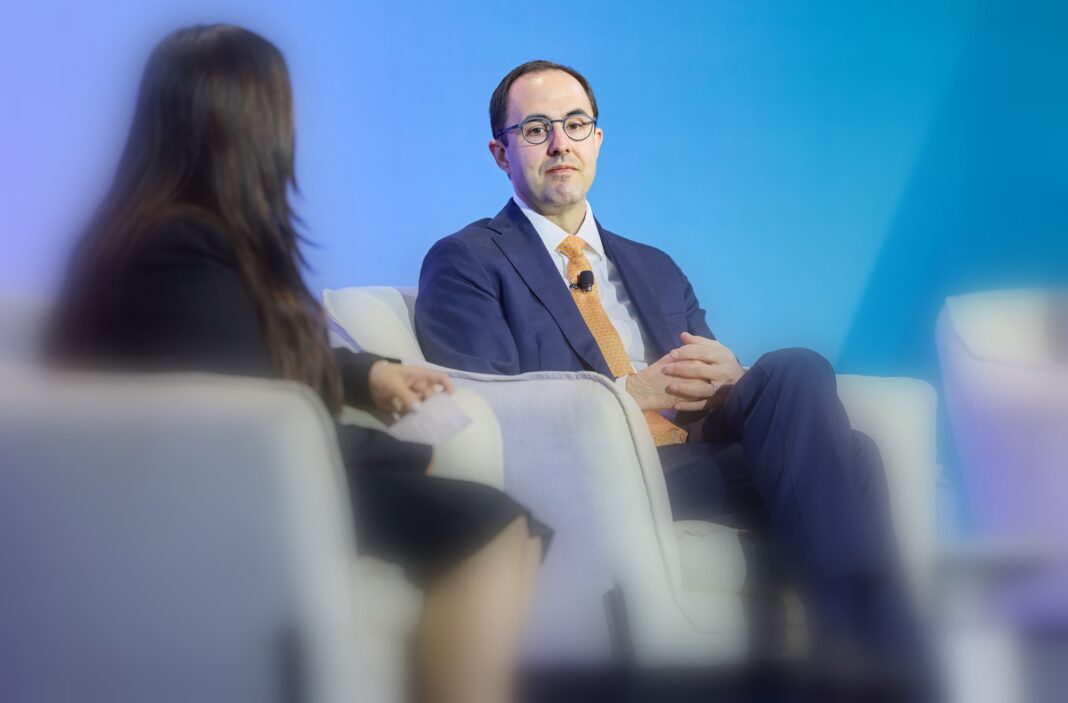
Exchange 2026 brought together experts and leaders from firms of all kinds to share ideas, showcase investment perspectives, and discuss the latest market innovations. Alex Morris, CEO of F/m Investments, sat down with the VettaFi team to talk about today’s fixed income environment, the F/m fund lineup, and much more.
Navigating Inflation in 2026
Nick Wodeshick: To get things rolling, the Federal Reserve’s rate cutting regimen amid shifting inflation data is making many advisors and investors rethink how they position their fixed income portfolios. Given your expertise in the field of fixed income, how are you and your team looking at the broader fixed income environment right now?
Alex Morris: The macro picture is driving a lot of volatility, and it changes day by day and hour by hour, often due to speculation in social media rather than actual information. The problem is that inflation is a generational issue, not a short-term problem. We never really solved the bout that started in late 2021. We’re not any closer to solving it now.
But the problem is easier for an advisor to address than a central banker. The advisor’s answer, I think, is equities. If you’re not comfortable there, and you are holding cash, you should diversify into some inflation protection, which means the TIPS markets.
The real question is what a central banker to do about all of this? In the short run, likely nothing. The risk is that inflation is back, and we have to hike rates up. The labor market’s cracking. Fuel costs are going to accelerate job loss. So maybe you need to cut to overcome those impacts, but you’re doing that while facing the risk that inflation increases.
Central banks have a really hard time articulating their strategies because they are a blunt instrument. Doing that with nuance is harder. We know how to fight inflation. We have no answer to fight deflation and no good answer to fight stagflation.
Why Dual Share Classes are Changing the Game
Nick Wodeshick: Turning to the F/m lineup—earlier this year, F/m Investments became the first issuer to launch a dual share glass fund with your flagship fund, the F/m US Treasury 3 Month Bill Fund (TBIL), which is now available as both an ETF and a mutual fund inside one portfolio. What drove your decision to push for a dual share class fund, and why TBIL in particular?
Alex Morris: Why dual share class? There’s a pool of assets that we really can’t access that are arguably being underserved by the current marketplace, retirement being chief among them, where you are stuck in a legacy structure. No one’s inventing interesting mutual funds. All of the innovation is happening in ETFs. If you’re a mutual fund builder, and you want any of these new products, you are out of luck. Even if we invented them today, or launched them two or three years ago, most of those major platforms won’t accept funds that have less than a three-, four-, or five-year track record. It’s a high bar.
In the ETF world, it’s much easier to get adoption. The 401 (k) world, the retirement world, has this great benefit. They can look at all the ETFs that have the track record they like. They can now ask to launch a mutual fund share class and invite them in. All of these advisory practices and fiduciaries want better, more interesting products to target chosen outcomes. I’ll stipulate that it’s harder and harder to do that.
Our TBIL ETF is a great product, given its design. It owns the most liquid and most secure investment—Treasury bills. It allows us to cut through a lot of the questions of speculative asset valuation and opacity. You know exactly what it is. It’s well priced. It’s easy to do. It’s liquid, so there’s no noise to get in the way from a conversion standpoint. You’re not better off in any one vehicle or the other. The ETF had some tax benefits that the mutual fund version wouldn’t have had, and now will.
Other than that, it had a lot of assets. It had a good market behind it. We had no incentive to cut any corner. We had 65 to 75 people on these calls, and we were ready to go months before all of it was finally approved. And we just spent those last few months testing everything again and again—examining potential second and third order effects.
We were never really fully satisfied until we pushed the button, because we were so engaged in making sure it was right. If this was a more complicated product that was smaller, you’d be more willing to take on some risks that you wouldn’t do with TBIL. TBIL is a really critical product to a lot of people.
The cardinal rule: do no harm to TBIL. When we do this, it must add value to the fund. When we can convince ourselves that we can do that—and we’re our own harshest critics—then we move forward. You will see us do this with other investment areas. You’ll see us do this in the inflation space, and some of the coupon payers. But it all comes back to that cardinal rule: it has to add value.
See More: F/m Launches Dual Share Class for TBIL Treasury Fund
The Advantages of Minimizing Dividends
Nick Wodeshick: Now, last year, F/m released two particularly interesting funds—the F/m Compoundr U.S. Aggregate Bond ETF (CPAG) and the F/m Compoundr High Yield ETF (CPHY). Can you go into a little more detail about how you and your team decided to offer these strategies, and why investors and advisors may want to consider implementing this approach within their portfolio?
Alex Morris: Total return is what investors see. We wanted folks to participate in that, particularly those looking at asset location decisions. But the seed of the idea had nothing to do with any of that. It had to do with something far more pedestrian.
It was really a desire for operational efficiency: how do we get you the best total return with the least friction possible in all elements of your life? We decided that while we can do this in an active version, and you’ll see us do active versions of it, we chose to do a passive one to prove to the world it wasn’t active magic. This is operational beta in its purest form. You buy a position, move toward a beta-neutral stance as closely as possible, and then rotate back out.
There are some benefits to that passiveness and there also are some attractive elements of going active in that space. You could do potentially fewer trades. You could buy funds that might have longer trails before their next dividend payment. There’s upside to that, and you’ll see us do that. Many folks love it for the total returns without the underlying friction that goes with collecting dividends.
Some of the problems come from the 1099, but the reality is that many of the issues are operational headaches. Say we declare a dividend on a certain day. When your broker-dealer receives it and when they invest it are not always one and the same. Sometimes, they’re four, five, or even six days out of the market. That’s free money you’re giving up, and I’m paying to do this low-quality transaction when I could just do nothing, and do it better and cheaper as F/m. That’s what really pushed us to do it.
You’ll see us do more in that space, particularly in things that are hard to trade, where we could get some buying power through the fund. So, BDCs, REITs, things of that nature. And also, high dividend paying equities, whether it’s through an ETF or directly, where folks just want to invest in total return, but don’t want to do any of the plumbing to get it. It’s not just retail investors. It’s institutional investors who don’t want a headache, or they might have one part of their business that’s taxable and one that’s not.
See More: New ETFs from F/m Aim to Minimize Dividend Tax Drag
Can Innovation Go Too Far?
Nick Wodeshick: Looking down the line—last year, ETFs saw a record $1.5 trillion in net inflows in 2025. Are you expecting that record to get beaten in 2026, and are you expecting fixed income funds to be a key driver of flows this year?
Alex Morris: Yeah, I suspect we’ll hit that number or reach new highs. I think a lot of it is demographic. It’s not market conditions as much as more active investors preferring the ETF to the legacy mutual funds.
Fixed income will be a bigger portion of it, but frustratingly, many of the leveraged or gambling products will continue to see big flows. They see the big fees, which is great for the companies, but I worry a little bit, are the folks willing to push the ‘40 Act to do innovative things, when the innovation is only based on adding risk? The ‘40 Act has 85 years of safety, security, and accumulated trust. It’s not the kind of thing to take out for a joy ride, and many of these strategies pick these binary outcome political contracts.
Those are fine for Polymarket. They’re fine for a pub bet. Taking the ‘40 Act and allowing people to do this in their brokerage accounts feels like we missed the message of why to do these things.
It’s not that they’re uninteresting. I just don’t see the economic value to it, or the economic substance. I don’t see the liquidity. I don’t see the things that make ETFs so investible. Yes, we can give all of those things to those investment concepts, but it doesn’t feel like that’s the best and highest use of the structure.
There is a lot of other really important work for the SEC and issuers to tackle. How do we get people to transition from legacy mutual funds to ETFs? How do we transition them to the digital economy? How do we get ready for financial agents, through AI, to actually interact with each other?
Whether or not the Democrats win or lose the House in November feels like a national voter electorate problem, not a Wall Street problem. I give the folks who are making these a lot of credit, it’s very creative. But I worry it might be too far, and we’re going to see more volatility.
For more news, information, and strategy, visit ETF Trends.