What happened to mortgage rates this week?
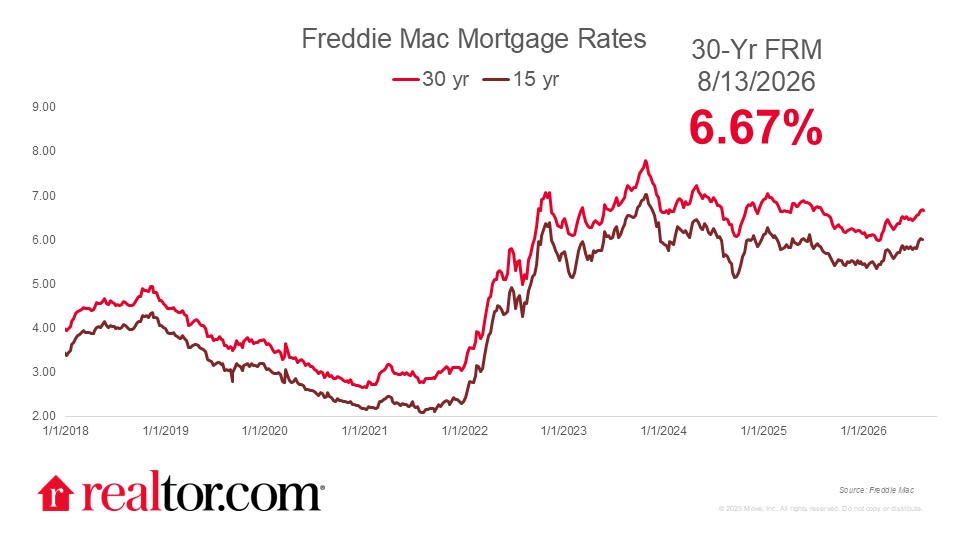
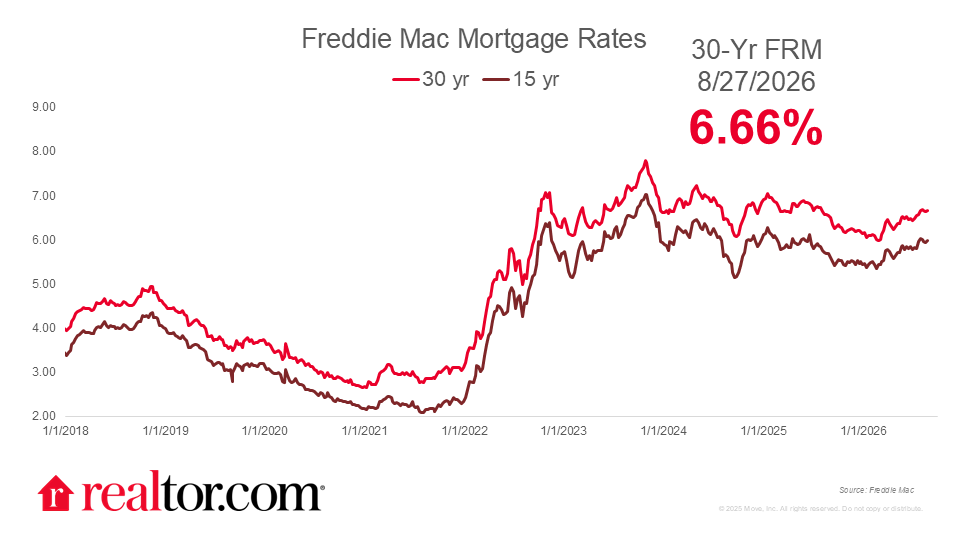
The Freddie Mac 30-year fixed mortgage rate held relatively steady this week, picking up 1 basis point to 6.66%. Rates have hovered in the mid-6% range over the past month as Treasury yields have stayed elevated. The 10-year Treasury has been choppy over the last month, bouncing between roughly 4.65% and a 20-month high near 4.75%, as markets digested shifting geopolitical tensions and inflation data.
July’s Personal Consumption Expenditures (PCE) report, the Fed’s preferred inflation gauge, came in a touch hotter than expected this week as inflation held at 3.7% annually rather than cooling to the 3.6% economists forecast. That kept the report from pushing yields meaningfully in either direction as it wasn’t hot enough to spark a hawkish repricing, but it wasn’t cool enough to build the case for near-term Fed cuts either.
What does this mean for the housing market?
All eyes now turn to Fed Chair Kevin Warsh’s address at the Jackson Hole conference on Friday, his first as chair. He’s expected to weigh in on still-elevated inflation and the ongoing Iran conflict’s ripple effects on energy prices. Markets largely expect a neutral tone, but because that neutral outcome is already priced in, any surprise has potential to move Treasury yields, and with them, mortgage rates.
Zooming out, mortgage rates have climbed for much of the year, driven largely by the Iran conflict’s effect on oil prices, which has kept inflation expectations, and by extension mortgage rates, elevated. That means buyers haven’t gotten much relief on the financing side. Home prices, however, tell a different story and the median listing price has now fallen year-over-year for nine straight months, down 2.4% in July to $428,950. Combined with growing inventory and homes sitting on the market slightly longer, this points to a market that’s rebalancing, giving buyers real room to negotiate even where rates haven’t budged.