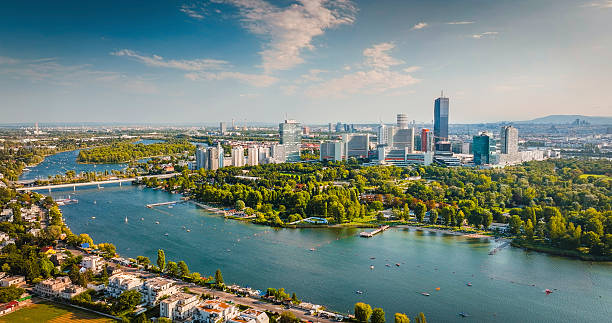

What is the fintech, digital and wider economic development in 2026 of Austria? The following goes in-depth into the European nation’s economy.
Austria’s fintech story is not immediately obvious. The country is relatively small, with a population of just over 9 million people. It does not announce itself with the scale of Berlin or the financial gravity of London, yet by 2026 it has become something more subtle and arguably more durable. It is a market where fintech is no longer a separate conversation, but an embedded layer within a broader, highly structured European financial system.
That distinction matters. Austria is not building fintech from the margins; it is integrating it into an already mature economy.
According to the World Bank, the country’s economic foundations are strong. With gross domestic product (GDP) estimated at roughly $520 billion and GDP per capita above $55,000, Austria sits firmly among Europe’s advanced economies. Austria’s economic model is diversified. It spans across manufacturing, industrial exports, services, and a sophisticated financial sector. Vienna, in particular, plays a dual role: both as the domestic financial centre and as a gateway into Central and Eastern Europe (CEE).
Within that context, Austria’s fintech ecosystem has evolved in a way that reflects its surroundings. It is not driven by explosive growth, but by depth and connectivity. The country hosts a growing number of fintech firms. As of last year it is estimated at over 200. They are operating across payments, digital banking, wealthtech, regtech and blockchain-related services. Yet many of these firms are not purely domestic in ambition. Instead, they use Austria as a base for regional expansion into neighbouring markets such as Germany, Hungary and the broader CEE region.
What is particularly notable is how fintech manifests itself in Austria: not as disruption, but as collaboration.
Banks remain central to the system, but they have adapted. Institutions such as Erste Group and Raiffeisen Bank International have invested heavily in digital platforms, mobile banking and API-driven services. Their approach has not been to resist fintech, but to incorporate it. This is either through partnerships, in-house innovation, or strategic investments. The result is a hybrid ecosystem where traditional finance and fintech increasingly overlap.
This is reinforced by Austria’s regulatory environment. As a member of the European Union (EU) and the Eurozone, the country operates within a highly harmonised framework, shaped by directives such as PSD2 and evolving open finance initiatives. Oversight from the Austrian Financial Market Authority ensures alignment with European standards, providing fintech firms with both stability and access to the single market. In practice, this means Austrian fintechs are often less focused on domestic disruption and more on scaling within a wider European ecosystem.
Payments, as in many markets, remain the most visible area of innovation. Digital transactions have continued to grow steadily, supported by strong card infrastructure, instant payment adoption, and increasing consumer preference for cashless solutions. At the same time, Austria has been part of broader European initiatives around instant payments and interoperability, positioning itself within a continent-wide shift towards faster, more integrated financial systems.
But Austria’s fintech narrative is not limited to payments. Wealthtech and regtech have emerged as important segments, reflecting the country’s strong asset management tradition and regulatory sophistication. Vienna, in particular, has become a hub for fintechs focused on compliance, digital identity and cross-border financial services. These are areas where European regulatory complexity creates both challenges and opportunities.
Beyond financial services, Austria’s digital economy has continued to expand. Government strategies have focused on digital transformation, innovation funding and startup development, contributing to a more supportive environment for technology-driven businesses. While Austria may not match the startup density of larger European hubs, it benefits from strong institutional support, high-quality infrastructure and a skilled workforce.
Financial inclusion, unlike in many emerging markets, is not a defining issue. Access to banking services is already widespread. The focus has therefore shifted towards efficiency and innovation. This is how to make financial services faster, more seamless, and better integrated into everyday digital life. In this sense, fintech in Austria is less about access and more about optimisation.
Still, the country faces its own set of challenges. Competition from larger European fintech hubs remains intense, particularly in attracting venture capital and high-growth startups. Additionally, the need to continuously innovate within a highly regulated environment can slow the pace of change, even as it ensures stability.
Yet this balance – between innovation and regulation, between growth and stability – is precisely what defines Austria’s fintech identity.
Not all fintech ecosystems are built to disrupt. Some are built to endure. Austria falls into the latter category: a market where fintech is becoming an integral part of a broader financial system, rather than a force attempting to overturn it.
By this year, Austria’s fintech landscape is less about emergence and more about integration. It is a system that works quietly, efficiently, and increasingly digitally. This is without needing to declare itself as revolutionary.