
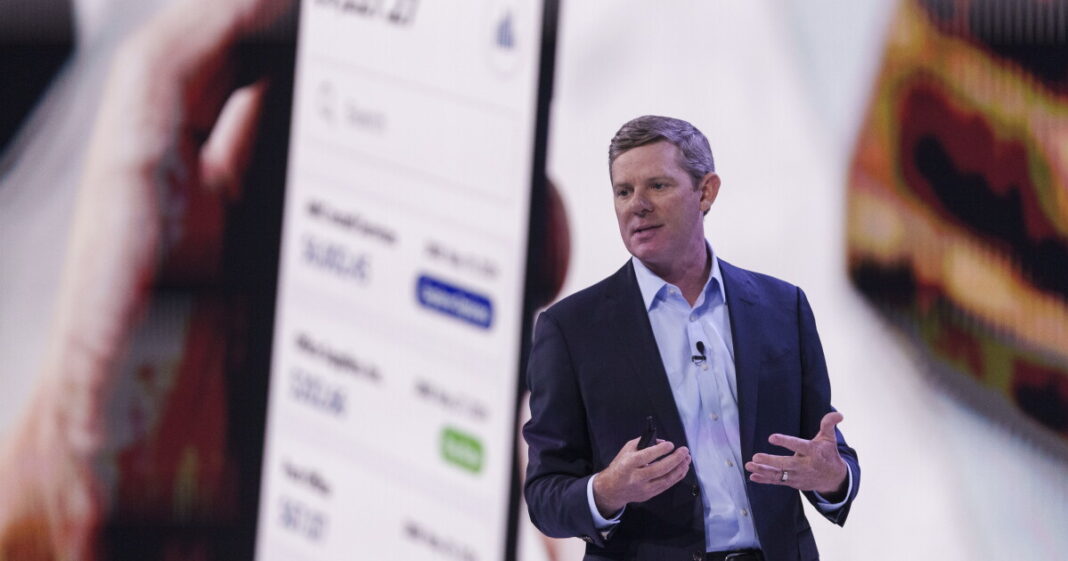
- Key insight: Visa’s earnings slightly beat analyst expectations as the card network announced layoffs.
- What’s at stake: The credit card company said AI has enabled it to develop products and technology faster, and to restructure how it builds new products.
- Expert quote: “AI is also helping to accelerate this evolution and shape the way work gets done at Visa,”— CEO Ryan McInerney
Shortly after American Express said
Processing Content
Visa will lay off 7% of its workforce, cutting about 2,600 jobs, a move that comes as banks and financial institutions pay close attention to the relationship between new forms of
“AI is also helping to accelerate this evolution and shape the way work gets done at Visa,” CEO Ryan McInerney said during Tuesday’s earnings call.
McInerney said improved efficiency was the reason for the cuts, adding that the proliferation and adoption of AI is a key factor — but not the only cause. A large portion of the impacted roles are in product and development teams. The layoffs will add $563 million in severance costs to Visa’s expenses.
As part of the restructuring, Visa will expand its investments in consumer and commercial payments; including blockchain, stablecoin technology, digital wallet technology, payment orchestration and related applications.
Visa has reformed its product development teams, which will now include two to four people as opposed to 10 people. The use of new forms of AI and the product team changes are enabling a 65% boost in feature development, the card network said.”We are going beyond AI assistants,” McInerney said, adding the company will increase the amount of work that is done without human supervision. “We are able to design, build and ship products with increased velocity.”
Visa’s earnings
For the quarter ending June 30, Visa reported net revenue of $11.6 billion, an increase of 14% from the same period last year. Payments volume grew 10%, as did processed transactiona. Net income was $5.6 billion, up 7%; and earnings per share landed at $2.97, up 11%. Adjusted earnings per share were $3.32, compared with analyst estimates of $3.23, according to FactSet. Revenue was $11.63 billion, up 14%, and compared with analyst estimates of $11.4 billion.
For the full year, Visa expects revenue growth in the “high end of low double digits,” which is slightly up from its prior projection of low double digits to low teens. Full year EPS will be low mid-teens, compared to low teens in its prior outlook.
“Consumer and business spending remains resilient,” McInerney said. Visa additionally benefitted from its World Cup sponsorship. Similar to
The increase was partly spurred by
Visa’s AI moves
In addition to changing work patterns, AI has been a big part of Visa’s value-added strategy (VAS), which grew 34% year over year in the current quarter and is about a third of Visa’s overall revenue.
Visa’s investments in AI during the quarter included AI Financial Assistant, which the card network says adds financial guidance into banking apps. The card brand hopes the AI assistant will bolster its services revenue by keeping card issuers and consumers from using third-party AI programs to build budgeting and other spending decisions.
The card brand additionally entered into partnerships with AI developer Alchemy and AI-powered cross-border payments platform Nuvion. While pushing
Read more:
Visa has also pushed
“Investor perception of competitive risk will shift as Visa highlights its right to win in agentic commerce and stablecoins,” William Blair analysts said in a research note, noting Visa’s AI focus on agentic commerce as a catalyst to accelerate global commerce digitization will create opportunities similar to debit, transit, and vending. “This makes sense and reiterates our view that cards are the most ubiquitous, safest, and efficient tender type. As a result, we believe agents will use cards, rather than other tender types, consistent with consumer preferences.”
Other recent moves tied to Visa’s VAS strategy include launching a product that embeds